Your best thinking, start to finish, on every deal.
What your organization knows about the problem you solve, captured once and put to work at every step of the deal.
Every room in the product, and the route one account takes through it: your point of view and the research feed the case, the seller and the champion work it, and it leaves as a one-pager, a deck or a link.
What Supercase does, and what the seller does.
Supercase does the preparation and the financial impact math. The seller refines the case for change with the buyer’s champion.
The shape of a case for change.
Most business cases start at the product and work backwards to a payback number, which is why finance discounts them. A Supercase starts at the buyer’s problem and has four parts that fit together: the narratives, the cost of inaction math, the financial impact math and the change plan.
- Problem / Fix Narratives
Problem, root cause and fix, backed by grounded research and tailored to the buyer's own priorities.
- Cost of inaction math
What staying still costs them, in their own numbers. Shown as a waterfall of KPIs, or as cost over time.
- Financial impact math
Cost of inaction less budget. Tweak the adoption curve and the implementation window for a realistic estimate.
- Change plan
Milestones, dates and budget for both paths, so the change looks low-risk.
Four things make it work.
Ask a chatbot for a business case and you get surface-level prose and numbers that can’t be checked. A Supercase is different in four ways: your point of view is the foundation, the research cites its sources, the money is calculated rather than generated, and every draft is checked before it ships.
What you know that no one else knows.
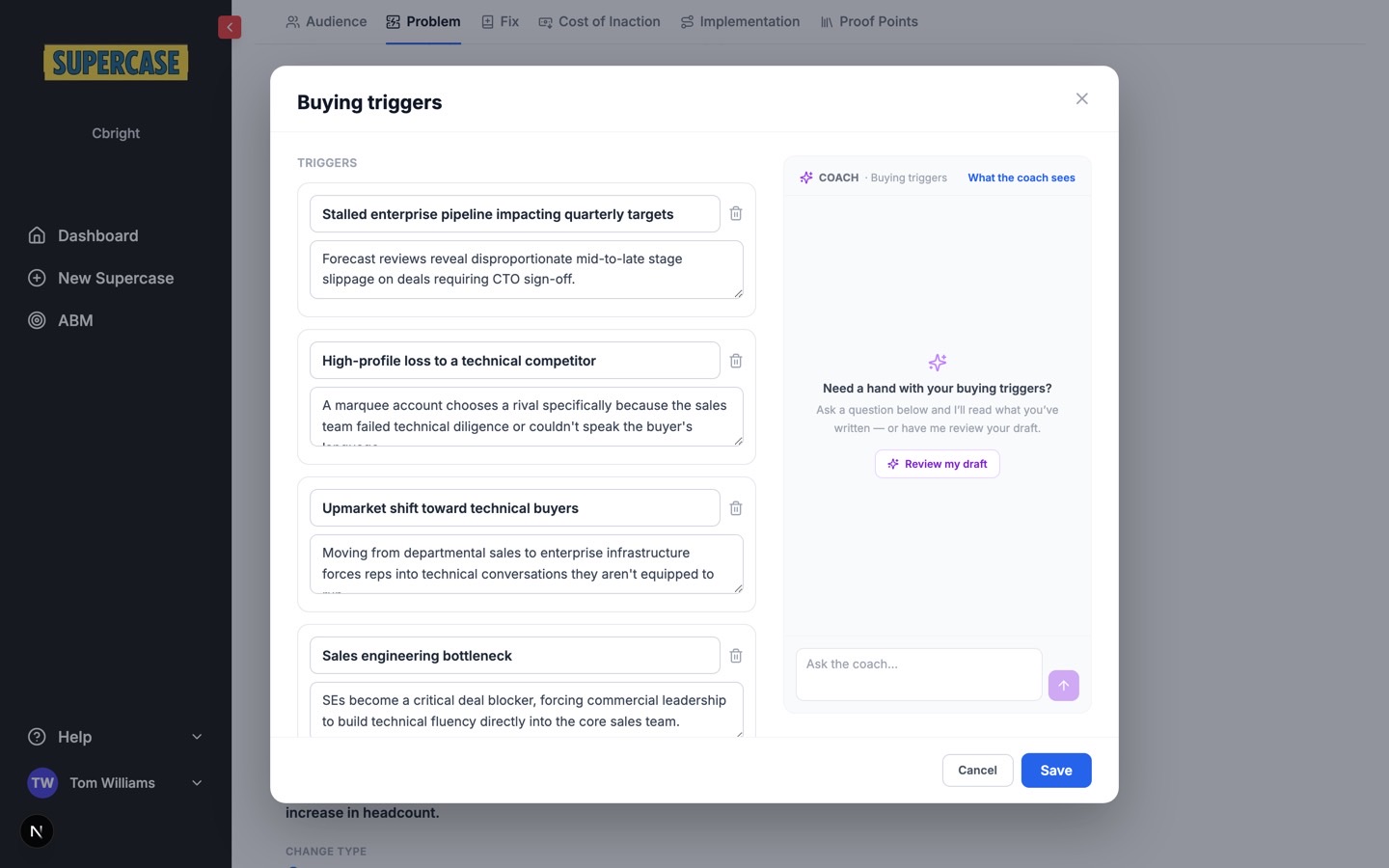
Your point of view is your org’s best thinking, synthesized from product marketing, enablement and your best sellers into a field-ready version of what you do and what you know: the problem you solve, why it persists and what fixes it. Written down once, it’s inherited by every case, so the core story of the business case is the same whether the rep is new or your best.
Serve more than one use case? Configure another point of view.
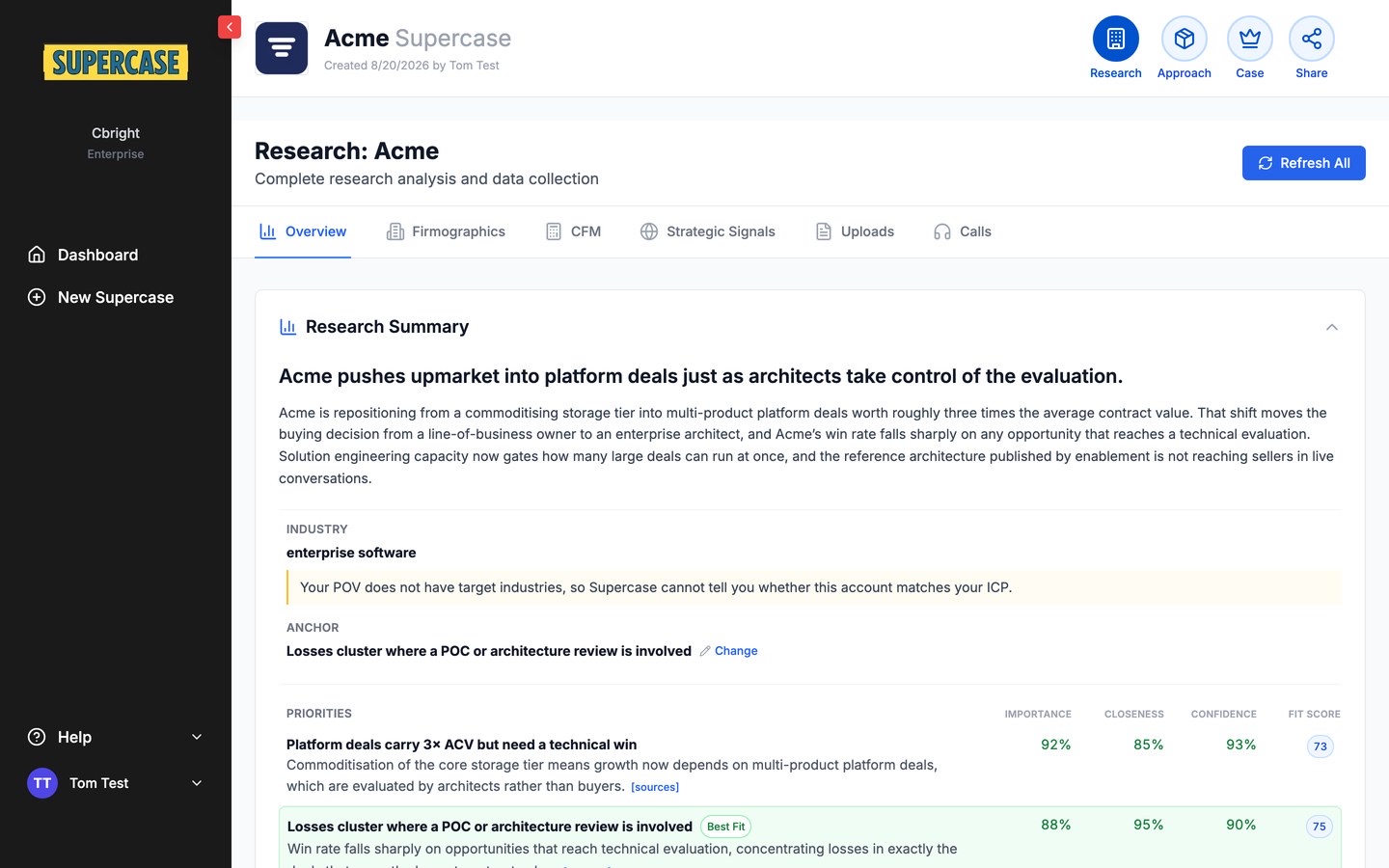
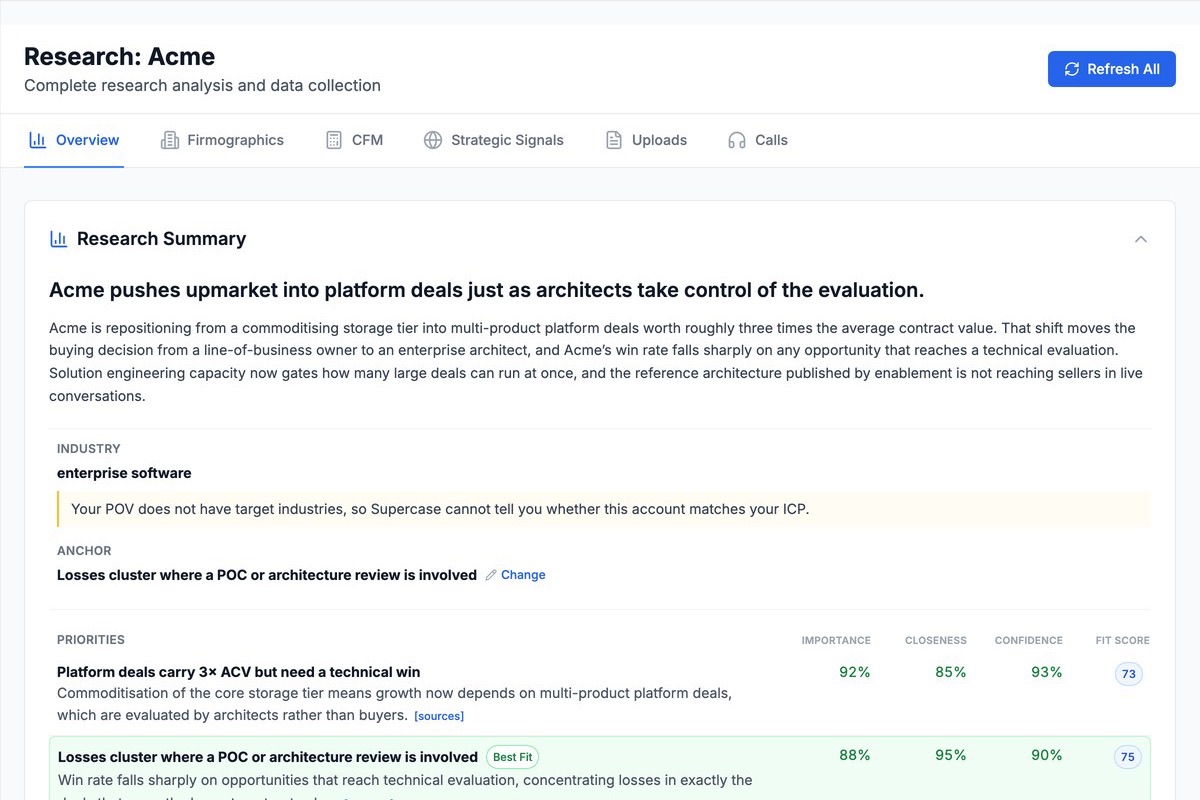
Their agenda, in their words, with a source on every line.
One pass reads their firmographics, SEC filings, site, news and job boards, together with the deal’s own calls and files, and every priority it finds cites a source. Then it scores which of their priorities best fits your org’s expertise, and anchors the case there.
No good fit? That’s a useful signal too. Other deals in the pipeline probably have higher potential.
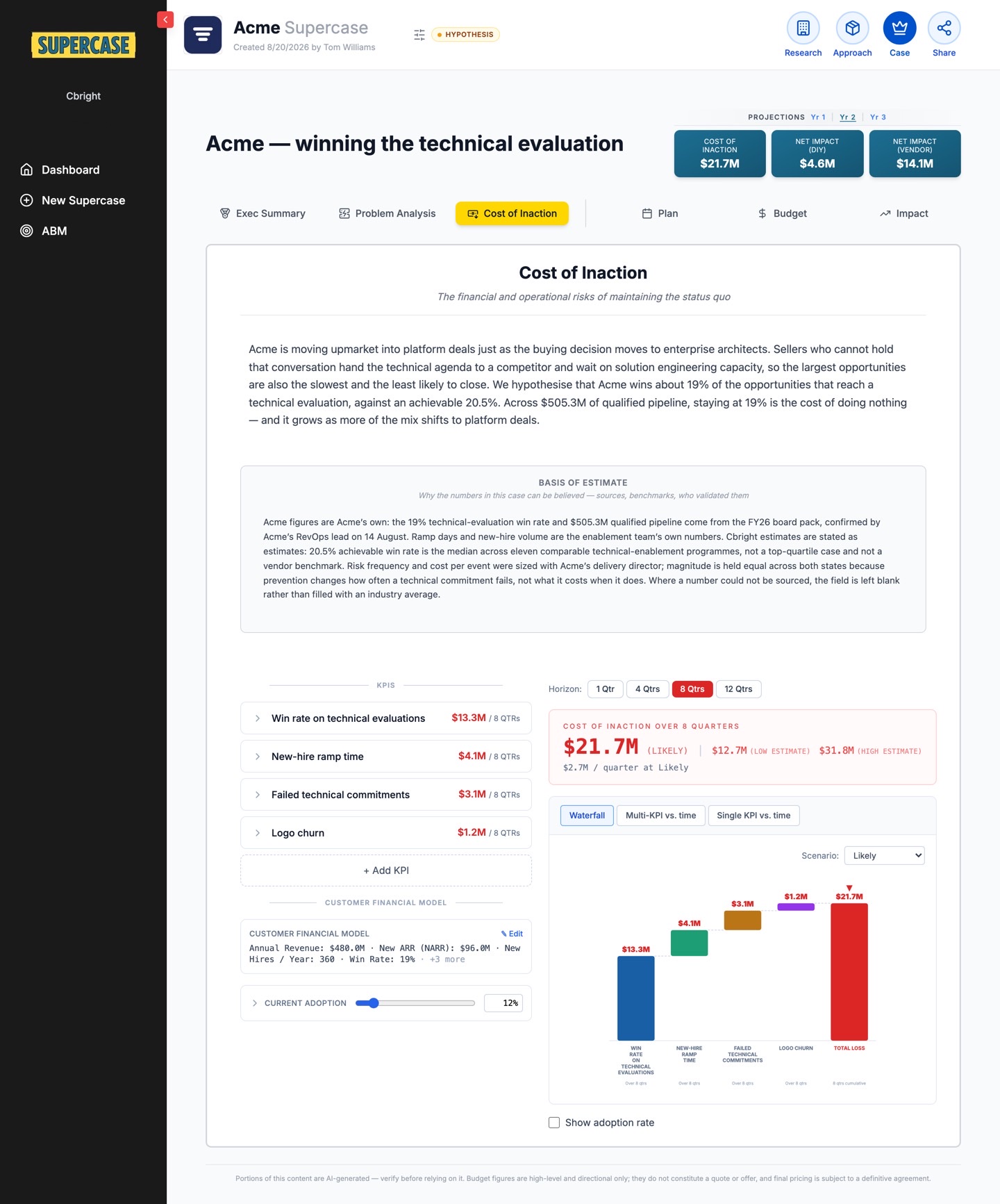
Cost of inaction and expected impact: calculated, not generated.
No language model touches the money. Every figure comes from deterministic math, so the same inputs give the same answer every time, and every number traces to a KPI you can read. That is the difference between a case finance can check and one it has to take on faith.
Every Supercase prices the cost of inaction (COI), also called the cost of delay: what staying still costs the buyer, in their own numbers, rather than a return the vendor asserts. Every starting value comes from the buyer’s Customer Financial Model, seeded from their real revenue, headcount and rates. The gap is carried forward over eight or twelve quarters as Conservative, Likely and Stretch, so the buyer sees the size of the impact over time, not one year’s figure.
| ROI calculator | Cost of inaction | |
|---|---|---|
| Starts from | the vendor | their business |
| The number | a multiplier, × 3.4 | two of their own: today 84%, achievable 95% |
| The output | $4,271,900, a point to the dollar | $4.2M to $7.1M, a range with the driver named |
| Adoption | assumed at 100% | modelled, and never 100% |
| Doing nothing | costs nothing | carries a price |
| Who owns it | nobody inside the buyer | their own model owner |
Prompts you can read. Checks that run every time.
The prompts that write the case are yours to edit, and every draft is checked before it ships: unsourced numbers are blanked, not softened.
The same checks keep the voice theirs. A hospital CFO and a logistics VP of Ops don’t get the same prose. Pick Consultant, Operator or Simplified, and the whole case restyles without regenerating. What changes is how it reads. What it says doesn’t change, and if a single number would move, the rewrite is refused.
Product features.
Everything in a Supercase, by layer. Pick one to see what it does and the screen it does it on.
Their agenda, in their words.
One pass reads their firmographics, seven web searches, job boards and, for listed companies, SEC filings, together with the deal’s own calls and files. Out come their priorities, initiatives and challenges, each with a source that resolves.
Add a call or a file mid-deal and the next refresh uses it. New evidence can reshape the priorities and move the anchor.
Two ways to start.
Four weeks. One point of view. Your first 10 accounts.
- W1First draft
- W2Working session
- W3Lock it in
- W410 accounts live
Try it on one of your accounts.
Free forever: the whole product, one active Supercase, no credit card.
Get started free